
A New Paradigm of Environmental Intelligence: From Real-Time Sensing to Trusted Insight
Executive overview
An industry whitepaper from Zhice Yunlian (Qingdao) Intelligent Technology Co., Ltd. on its independently developed ZhiCloud Environmental Agent Cloud Platform, connecting real device data, regional environmental context, industry knowledge and trusted insight across six operational domains.
Visual overview
ZhiCloud customer capability map
| Customer capability | Business expression | Organizational value |
|---|---|---|
| Global environmental questions | Ask in natural language across authorized devices and time windows | Shortens information retrieval and briefing |
| Data overview | Organizes current conditions, change and scope | Creates a shared situation picture |
| Anomaly insight | Surfaces notable changes with context for review | Focuses specialist attention |
| Trend foresight | Describes direction, window and conditions | Supports earlier preparation |
| Integrated assessment | Connects telemetry, weather, records and industry materials | Improves decision continuity |
| Intelligent reports | Turns inquiries and evidence into shareable records | Supports meetings, handovers and review |
Six industry landscapes
| Domain | Recurring user problem | ZhiCloud value |
|---|---|---|
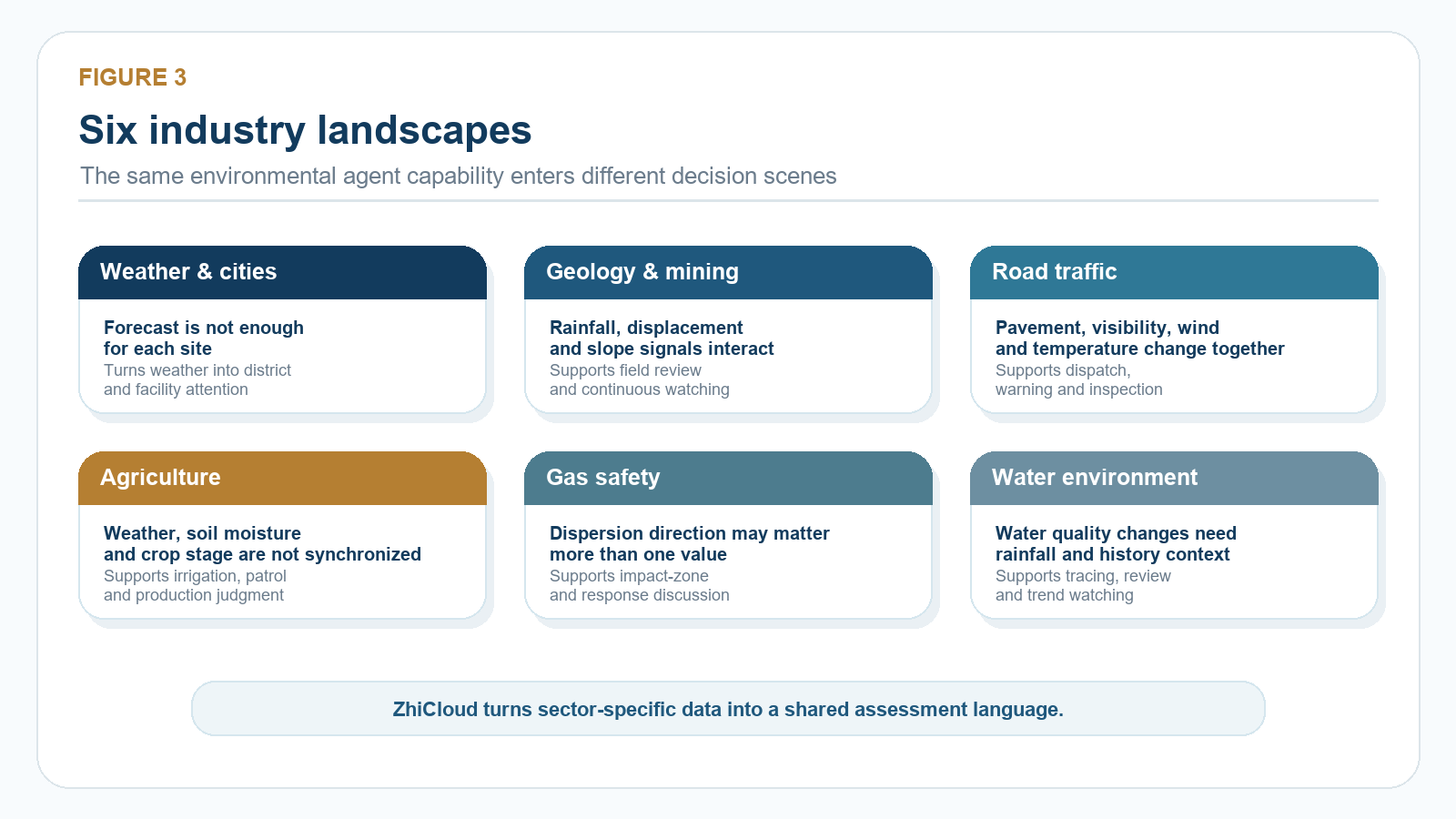
| Weather and cities | A regional forecast does not explain every district or facility | Connect weather context with local sensing and operational objects |
| Geology and mining | Displacement, rainfall, groundwater and activity are reviewed separately | Organize interacting signals into review leads |
| Road traffic | Pavement, visibility, wind and temperature change together | Support dispatch, inspection and warning discussion |
| Agriculture | Weather, soil moisture and crop stage are often disconnected | Support irrigation, patrol and production judgment |
| Gas safety | One concentration value does not explain dispersion or impact | Combine change, wind context and site records |
| Water environment | Water-quality shifts need rainfall, flow and history | Support tracing, review and trend observation |
From environmental monitoring to environmental intelligence
01 Executive summary
Environmental governance is entering a new stage. In the past, organizations strengthened management by adding sites, devices and historical records. Today, the scarce capability is not data itself, but the ability to return data to its environmental context, form a stable understanding and support responsible action. Environmental intelligence is becoming a new connective layer between natural systems, cities and industries.
Environmental intelligence is not a black box that takes responsibility away from professionals. It connects real-time sensing, environmental understanding, foresight, trusted insight and action support. It turns isolated indicators into a situation, a warning into a risk narrative and a one-off report into decision continuity. Its value is to help experts notice earlier, understand faster and coordinate with greater confidence.
The new paradigm from real-time sensing to trusted insight is represented by ZhiCloud Environmental Agent Cloud Platform, independently developed by Zhice Yunlian (Qingdao) Intelligent Technology Co., Ltd., as an environmental agent cloud platform for public-sector and enterprise workflows. Through weather, geology, roads, agriculture, gas and water environments, ZhiCloud organizes customer-facing environmental agents into industry-grade capabilities for asking, observing, forecasting, assessing and reporting. The focus is capability, evidence, governance and organizational learning rather than implementation detail.
In practical public-sector and enterprise work, the first value of environmental intelligence is to make complex situations understandable. Field teams need to know what to check, specialists need to see whether evidence is sufficient, and managers need to understand impact and responsibility. ZhiCloud places these needs in one language so monitoring results become decision material rather than isolated charts.
ZhiCloud's advanced capability is therefore not a technical spectacle. It is a business loop in which real devices, regional climate context, public information, industry knowledge and organizational memory support one another. Environmental data moves closer to the decision scene, and decision-making moves closer to the facts.
Environmental intelligence should be measured by an institution's ability to answer three operational questions: what has changed, why the change matters, and who must verify the next step. ZhiCloud places continuous telemetry, regional weather, historical records and sector material in one decision context, giving leaders a situation view, specialists an evidence path and field teams a practical focus.
This shift changes the place of environmental data inside an organization. Data no longer appears only during acceptance or monthly reporting; it supports inspection planning, meeting preparation, anomaly review and resource deployment. Zhice Yunlian is building a durable capability that begins with real sensing, creates shared understanding and supports responsible action.
02 Industry transition: from data accumulation to intelligence
Environmental issues are cross-scale, cross-department and cross-cycle by nature. A severe weather event can affect transport, parks, agriculture and drainage at the same time. A geological disturbance can look entirely different across time windows. The same metric may require a different interpretation depending on terrain, season and operational purpose. More data alone does not create better judgment.
Traditional workflows often follow a collection, storage, export and reporting sequence. With every handoff, context is compressed, anomalies are separated from their surroundings and accountability becomes harder to see. Leaders receive fragments of the outcome, but not always the pace of change, the area of impact, the strength of evidence or the next object that deserves attention.
The transition to environmental intelligence moves data work from the back office to the front line of understanding. The essential questions become: what is happening, why does it matter, how might it evolve, what evidence supports the view and what should be checked next? This is the grammar of intelligent governance.
In real projects, a data silo is usually also a collaboration problem. Device records, weather information, historical reports, field notes and professional explanations often sit in different places. When an event occurs, the slowest part is not seeing data; it is assembling data into a view that can be discussed.
ZhiCloud addresses this friction by combining search, comparison, explanation and briefing into one continuous conversation. Users can begin with a natural business question, receive a structured situation view and then expand the evidence level by level.
Traditional monitoring projects often treat device connectivity and data storage as the finish line. The work that affects decisions begins later: records from different systems must be aligned, anomalies must be compared with weather and field conditions, and departments must agree on a common account. The longer this chain becomes, the more an organization depends on a few people who remember the project's history.
Environmental intelligence moves the objective from collecting data to using data in judgment. Devices remain the factual foundation, while the platform connects object, time, place, history and accountable role. Non-specialists can ask directly, specialists can inspect the basis, and teams spend less time moving information between systems and more time confirming what matters.
03 The new paradigm: sensing to trusted insight
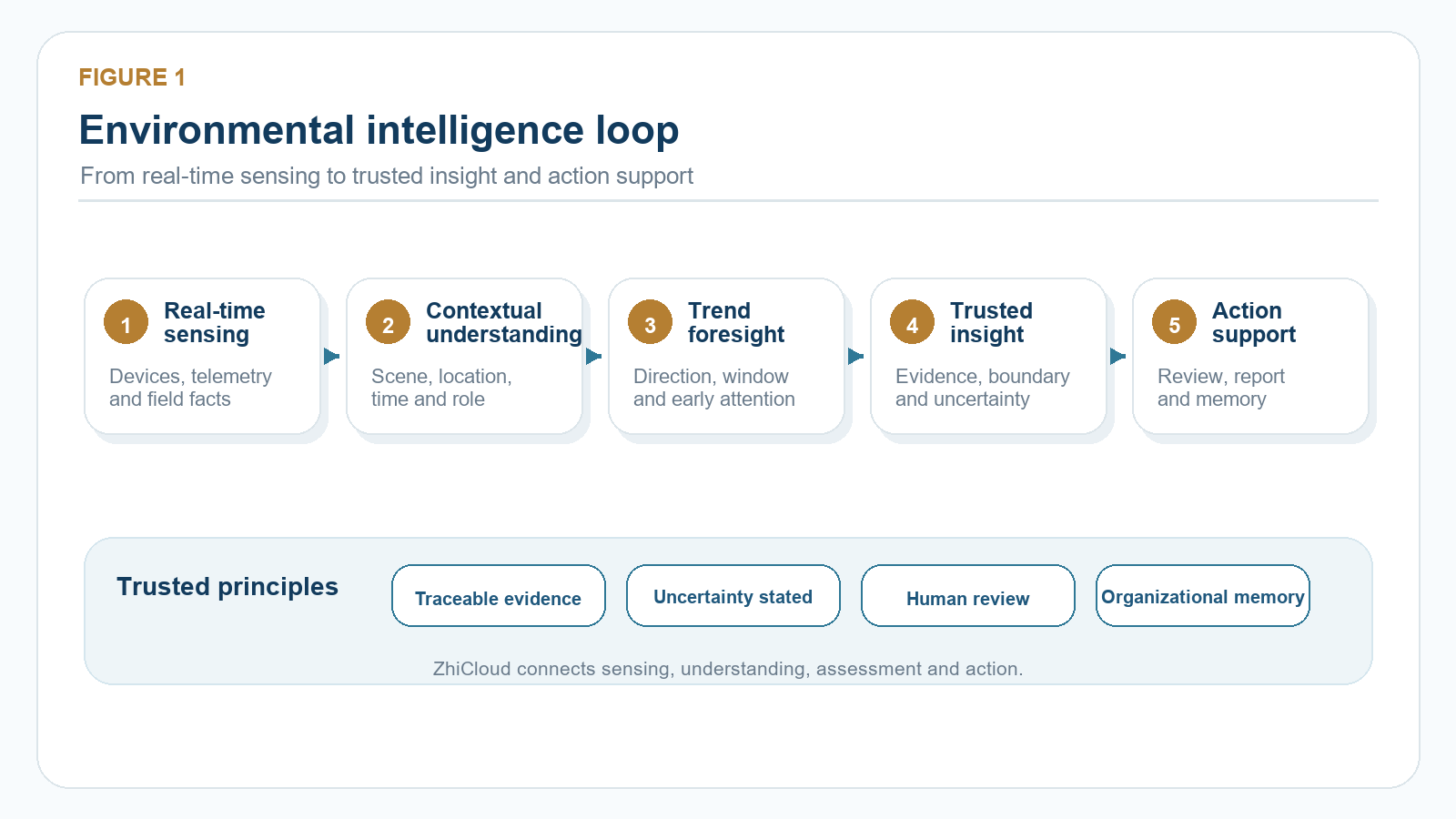
The new paradigm has five connected movements. Real-time sensing establishes the present fact base. Environmental understanding places measures in the context of place, object and sector. Foresight considers direction and pace. Trusted insight makes evidence, confidence and uncertainty visible. Action support turns understanding into work that can be discussed, assigned and reviewed.
These movements are not a one-way pipeline. New telemetry revises understanding, field feedback changes priorities and a new seasonal or policy context changes what matters. Environmental intelligence is therefore closer to a system with memory, explanation and review than to a more elaborate dashboard.
The operating principle is human and machine judgment together. The platform shortens the distance between information and the decision table; professionals confirm boundaries, weigh public impact and authorize action. Sophistication should be felt as composure in judgment, not as a larger vocabulary of technology.
The new paradigm also turns environmental monitoring from one-time project delivery into long-term cognitive operation. Every telemetry series, anomaly, human confirmation and report can strengthen the organization’s understanding of a place, device group or environmental process.
For users, the change is immediate: ask one question to understand the situation, ask a follow-up to inspect evidence, then generate a report for review. The environmental agent becomes a professional intermediary between complex data and accountable work.
Real-time sensing establishes current facts; environmental understanding explains their context; foresight introduces time; trusted assessment states evidence and uncertainty; action support assigns the next confirmation to an accountable role. When these movements form a loop, a short briefing can expand downward to source material and forward to a review task.
The paradigm does not seek to replace professional judgment. It makes that judgment easier to reach by organizing complex situations into material that different roles can understand before qualified people confirm impact, boundaries and action. The agent becomes a cognitive interface between environmental fact and institutional work, rather than a detached chat window.
04 ZhiCloud Environmental Agent Cloud Platform: capability map
ZhiCloud Environmental Agent Cloud Platform is not a simple collection of AI features. It is the industry agent foundation independently developed by Zhice Yunlian (Qingdao) Intelligent Technology Co., Ltd. around environmental governance scenarios. Its customer-facing environmental agents organize real-time sensing, environmental understanding, foresight, trusted insight and action support into a coherent work system, designed for industry-leading practice. The global assistant is a natural-language entrance; the data overview brings devices, measures, time range and data quality into view; anomaly insight turns notable change into a clear observation lead.
Trend forecasting considers possible direction over a future window and remains an aid rather than a promise. Multi-source assessment brings telemetry, weather outlooks, research information and sector rules into one readable narrative. Intelligent reporting turns a judgment into a formal record that a team can preview, review and continue to discuss.
Together these environmental agents form a path from asking to seeing, from seeing to assessing and from assessing to a durable record. They are designed for customers to use directly in daily work, so different roles can share one environmental fact base without every participant becoming a data specialist. The result is an industry-grade ZhiCloud experience: sophisticated in capability, restrained in disclosure and accountable in use.
ZhiCloud’s capability map can be read as an environmental judgment line: device data enters the platform, objects are understood, changes are interpreted, trends are assessed, reports are produced and the organization receives material it can act on.
This positioning shapes a disciplined public boundary. Customers see business capability, industry value and governance method rather than underlying models, internal processes or replicable implementation details.
The six customer-facing capabilities perform different work. Global assistance creates a natural entry point, overview establishes the factual baseline, anomaly insight identifies meaningful change, forecasting explores direction, multi-source assessment organizes relationships, and reporting preserves a stage of judgment. Each stage supplies context to the next instead of operating as an isolated feature.
The map also supports different depths of use. Leaders may remain at situation and priority, specialists may inspect indicators, sources and time windows, and field personnel may focus on review objects and handover. One factual base can therefore serve several roles without flattening the professional depth needed for serious work.
The ZhiCloud capability system
05 Global assistance: open understanding with a question
A global assistant matters because users can speak in the language of governance: Has a region changed persistently? Is a device deviation worth a field review? Which conditions could alter the current view in the next few days? The question comes before the interface, and intent comes before the field.
A useful answer does not need to sound absolute. It should establish scope, evidence and the next check. It should identify the device or area and time window, indicate data completeness and distinguish what still requires human confirmation. For public-sector and enterprise users, this restraint is more valuable than theatrical certainty.
The assistant also translates across roles. A leader receives a concise view, a specialist can inspect supporting evidence and a coordinator can see an action cue. The language changes by role while the underlying fact stays stable, reducing the cost of coordination.
Global assistance is not valuable because it can chat. It is valuable because it can maintain a conversation around a real environmental object. A user may ask about an entire park, a slope, a road segment, a field or a water body, then continue into device range, time window and evidence.
For non-specialists, this lowers the threshold of understanding. For specialists, it reduces repeated preparation. For managers, it creates faster access to situational awareness while preserving a path to deeper evidence.
A question such as “Which sites need attention today?” contains hidden conditions about scope, period, indicators, device status and environmental background. Global assistance identifies the object of interest, gathers the related continuous data and material, and provides a structured view. The user can then pursue one location, one curve or one piece of evidence without rebuilding the search.
Ongoing dialogue helps the platform understand working priorities. Facility leaders tend to ask about overall status, engineers about causes, and project managers about reports and handover. User models, dialogue memory and device environment files preserve context so each role receives suitable depth while the underlying facts remain stable.
06 Data overview and anomaly insight
A data overview is not a pile of measures. It is a quick portrait of an environmental object: current state, recent movement, data quality and the scope that deserves attention. Devices, indicators and time are seen together, allowing a new participant to find the discussion point quickly.
Anomaly insight should not label every deviation a risk. It should help distinguish a short fluctuation from a persistent change, a single signal from an associated movement and an observation from a question that needs more evidence. A contextual anomaly is more useful than a red mark without a story.
For an organization, shared insight creates shared attention. Different teams can work from one fact sheet rather than circulate disconnected screenshots. Coordination moves from forwarding results to building a common understanding.
A useful overview should answer more than how many devices are online. It should indicate which objects are stable, which are changing, where data quality requires attention and what deserves follow-up. ZhiCloud treats overview as the first step of assessment.
Anomaly insight should also avoid creating noise. It should distinguish short fluctuations, persistent shifts, linked movements, data gaps and issues requiring field confirmation. This makes insight suitable for meetings, patrols and review.
A useful overview begins with coverage and data condition: which devices continue reporting, which indicators remain within their usual ranges, which sites show material change, and which records should not support judgment because of gaps or quality concerns. Showing integrity alongside environmental change helps prevent collection faults from being mistaken for field events.
Anomaly insight then examines shape rather than one threshold crossing. A short spike, persistent drift, changed cycle, coordinated movement across indicators or divergence between nearby sites creates different review paths. ZhiCloud separates observation, possible influence and open confirmation so an alert can enter inspection, consultation and review.
07 Trend forecasting: bringing time into judgment
Environmental risk often depends less on whether one instant crosses a line than on whether a change persists, accelerates or moves with other factors. Trend forecasting adds time to environmental understanding, allowing leaders to ask not only what is true now, but what may become important next.
A trusted trend statement must show its limits. A forecast supports preparation; it does not replace observation. It should communicate direction, window and relevant conditions, while pointing to continuity, seasonality and field context. The easier an output is to act upon, the clearer its uncertainty must be.
When forecasting becomes part of a routine, it can inform inspection priority, resource preparation, meeting agendas and review cycles. The result is not an oracle-like curve, but the ability to organize attention earlier.
Forecasting in environmental scenarios requires disciplined language. Rainfall, water level, displacement, gas concentration and soil moisture can all be affected by season, terrain, device condition and field activity. ZhiCloud emphasizes direction, window and influencing factors rather than false certainty.
The business value is attention management. Users need to know whether to schedule patrols, intensify observation or add a point to a coordination meeting. Forecasting becomes a way to prepare the organization.
Environmental trends are conditional. The future movement of rainfall, water level, displacement, temperature, gas concentration or soil moisture can be shaped by season, terrain, device condition and site activity. A responsible forecast therefore states the observation window, direction, major influences and missing evidence instead of presenting one curve as certainty.
For customers, the useful output is lead time. Road teams can prioritize segments, farms can adjust irrigation observation, mines can increase attention to related points, and water managers can prepare upstream and downstream checks. Forecasting manages organizational attention and leaves a record that can later be compared with what actually occurred.
08 Multi-source assessment: from metric to narrative
Complex environments rarely yield to one source. Telemetry describes the field, weather provides external context, research contributes a reference frame and sector rules provide governance meaning. Multi-source assessment organizes these materials into a readable evidence chain so that users can understand why a view was formed, not merely that a system produced one.
Sources may disagree in time, space or reliability. A mature assessment keeps those differences visible and leaves room for human review and supplementation. Intelligence is not the elimination of disagreement; it is the ability to make disagreement legible and testable.
This is particularly valuable for cross-department briefings. A shared assessment supplies common material for a meeting, common language for assignments and a record for later review. Environmental governance gains continuity without pretending that uncertainty has disappeared.
Multi-source assessment is difficult because sources rarely align perfectly. Forecasts have regional scale, sensors have local scale, public information has release time and applicability, and field notes have operational context. A mature platform makes these differences visible.
ZhiCloud organizes assessment around fact, relationship, impact, suggestion and open confirmation. Managers receive the conclusion, specialists receive the evidence chain, and field teams receive clear review objects.
Multi-source assessment does not blend every source indiscriminately. Field sensors provide continuous facts closest to the object, weather material explains regional processes, public environmental data supplies a broader reference, sector documents provide professional context, and human records describe conditions that instruments cannot capture.
Agreement among sources strengthens a view; disagreement becomes a lead that requires explanation. ZhiCloud organizes the material around object, time and spatial relationship, distinguishing observation, interpretation and open confirmation. The assessment can therefore carry a broad perspective without hiding the local facts on which action depends.
Weather, cities, geology and mining
09 Intelligent reporting: turning a judgment into an asset
An intelligent report is not a screen dump. It organizes scope, observation, evidence, risk, recommendation and open questions into a structure that can support a briefing, a project archive, a periodic review or the next judgment.
Its quality comes from narrative order. It begins with the question and boundary, presents the material change, explains the relationship among sources and closes with actions for discussion and items still to confirm. Summary, professional and review layers can present the same facts at different depths, but the factual basis must remain consistent.
Once a report can be previewed, downloaded and shared, environmental intelligence becomes organizational memory. A judgment no longer disappears when a meeting ends; it becomes an artifact that can be found, explained and refined.
An intelligent report turns temporary judgment into transferable material. It can support a meeting, a project archive, a regulatory conversation or an internal risk review. Its value is not decoration; its value is retained context.
A strong report clarifies scope, states key observations, explains evidence, describes trend and leaves responsible review items. That is how a report becomes an organizational asset instead of a screenshot.
An intelligent report should preserve the complete context in which a view was formed, not merely format a conversation. It identifies the object and period, records material changes and evidence, states the conditions of a forecast, and keeps confirmed items, open questions and accountable next steps visible for execution and later review.
Organizational continuity grows from such inheritable material. New participants can understand why a site drew attention, leaders can compare stages, and specialists can determine whether the evidence has changed. When a report remains connected to device files and dialogue history, a temporary assessment becomes durable project memory.
10 Six industry landscapes
In weather, environmental intelligence links changing conditions with regional operations, supporting risk briefings, resource planning and public communication. In geology, it helps relate long-term movement to short disturbances and provides a review lead for field teams. In roads, weather, traffic context and observation can be considered together.
In agriculture, it turns crop, soil, water and weather rhythm into a management conversation that helps operators keep pace under uncertainty. In gas safety, it brings attention to direction, area of influence and coordination so that awareness moves earlier. In water environments, it places water quality, hydrology, weather and surrounding activity in a fuller narrative.
These are not closed verticals. They demonstrate a common idea: the core is not a sector-specific algorithm, but a way to turn continuous facts into judgment that a sector can understand, an organization can coordinate and a responsible person can review.
The six industry landscapes must be separated because their risk languages differ. Urban weather focuses on public operation, mining on movement and safety, roads on passability and maintenance, agriculture on crop rhythm, gas safety on dispersion and exposure, and water on quality, flow and upstream-downstream relation.
ZhiCloud’s industry agents do not merely change page labels. They organize judgment around different objects of responsibility, so customers hear relevant professional language rather than generic AI commentary.
The six domains share environmental data but act on different objects. Urban weather concerns public operation and facilities, mining concerns slopes and operational safety, roads concern travel conditions, agriculture concerns crops and water, gas safety concerns dispersion and exposure, and water environments concern upstream-downstream processes and quality.
An industry agent must use the observation and responsibility language of its field. The same rainfall can mean drainage and slipperiness for roads, displacement and groundwater context for a mine, or soil moisture and field access for agriculture. ZhiCloud keeps the facts consistent while making interpretation relevant to the task.
11 Public-sector and enterprise value
For public agencies, environmental intelligence first reduces the time required to prepare a judgment. Its deeper value is coordination: different departments can work from the same fact base, reducing gaps and repeated interpretation.
For enterprises, it brings risk awareness into daily operations. Parks, transport, agriculture, energy and water teams can observe continuously, prepare before a problem grows and retain a fuller record for review after an event.
The most durable value is continuity. Staff changes, shifts and meetings should not reset environmental understanding to zero. Explainable insight, reviewable reports and clear permission boundaries give an organization a steadier memory in a complex world.
Public-sector and enterprise value should not be reduced to efficiency. Government users need coordination, public communication and policy implementation support. Enterprise users need asset safety, continuity, compliance record and operational review. The common value is better judgment.
When facts, trends and evidence are organized into one material set, collaboration starts from the same basis. Leadership, specialists and field teams can align faster without losing their different responsibilities.
Public administration emphasizes regional awareness, cross-department consultation, public risk communication and local execution. Enterprises emphasize asset safety, production continuity, compliance records and resource planning. Both struggle when data remains divided among systems and roles and must be repeatedly assembled before a common view can emerge.
Environmental intelligence moves collaboration to a shared factual starting point. Leadership sees influence earlier, professional teams inspect the basis directly, and field teams receive a clear direction for checking. Faster work is the visible result; the deeper value is continuity of understanding and decision-making in changing conditions.
12 Principles of trusted intelligence
Traceable evidence: every consequential view should lead back to a clear time window, device or area, source and version. Traceability creates an entry point for review and a boundary for responsibility.
Expressed uncertainty: a trend, an assessment and a recommendation should distinguish fact, inference and open question. An intelligent platform can accelerate judgment without hiding the complexity of the environment.
Human review and permission boundaries: intelligence supports people and does not cross the authorization boundary for a public-responsibility decision. Each role should see and do only what its responsibility permits.
Data responsibility: providers, users and decision-makers share responsibility for quality, applicability and consequence. Respect for data is part of using intelligence well.
Trusted intelligence must answer both what the platform can support and what it must not decide on behalf of people. ZhiCloud can discover change, assemble evidence, suggest trends and produce reports, while accountable decisions remain with authorized roles.
This restraint protects long-term adoption. A system that clearly states evidence and limits is more suitable for serious public-sector and enterprise use than a system that appears all-knowing.
Trust begins with traceability. Every important view should return to an object, collection time, source and applicable scope. A trend should state conditions and uncertainty, while an action suggestion should identify the person who must confirm it. Users can then understand both what supports the view and which responsibility remains outside the system.
Human review is not an attachment to intelligence; it is part of trusted assessment. The platform shortens discovery, organization and explanation, specialists judge whether evidence is sufficient, and authorized roles weigh consequences and decide action. Clear role boundaries allow environmental intelligence to enter public-safety and production settings responsibly.
Roads, agriculture and operational safety
13 Adoption path: establish a shared language
Adoption does not have to begin with a complete transformation. A safer path starts with one scenario that has continuous data, a named owner and a real decision need. Build the smallest loop from sensing to understanding to review, then extend the method to adjacent scenarios.
The first stage establishes a shared language: object, time window, question and expected decision material. The second establishes a coordination rhythm by placing assistance, overview, insight, forecasting and reporting inside meetings, inspections and briefings. The third turns review into learning and makes the platform part of governance.
Measure adoption by more than call volume. Preparation time, cross-team alignment time, review completion, reuse of decision material and the clarity of uncertainty records reveal whether intelligence has improved the quality of work.
Adoption should begin with a real problem. A park may start with rainfall and waterlogging, a mine with slope displacement, a road authority with icing, and an agricultural user with soil moisture. The more concrete the scenario, the easier the loop is to validate.
Expansion should come from learning. Which questions are asked most often, which evidence is most useful, which reports are reused and which roles need different expression? Those answers define a sustainable adoption path.
Adoption should start with a recurring issue whose responsibility is clear: storm preparation at a facility, slope movement at a mine, cold-weather road inspection, field moisture management or water-quality fluctuation. The team first defines the object, data window, users and review process, then tests whether assistance, insight, assessment and reporting create a small closed loop.
Expansion should follow evidence from use. Which questions recur, which sources support judgment, which steps still require manual transfer, and which reports are reused? Turning those answers into an institutional method before adding nearby devices and regions avoids a broad launch that lacks an operational loop.
14 Outlook: environmental intelligence as infrastructure
The environmental infrastructure of the future will not simply place more sensors in the field. It will connect sensing, understanding and governance over time. Data becomes environmental memory, intelligent capability becomes a cognitive partner and the organization remains the responsible actor.
As regional, sector and organizational connections deepen, environmental intelligence can support longer-horizon observation, richer cross-domain briefings and more careful public communication. It does not flatten professional differences; it makes expertise easier to bring into a shared workflow.
The goal is not decision-making without people. It is decision-making with evidence, intelligence with boundaries and governance with continuity. That is the long path from real-time sensing to trusted insight.
Future infrastructure will combine sensing networks, cognitive platforms and organizational workflows. Sensors provide facts, the cloud organizes memory, agents provide assessment language and workflows preserve responsibility.
Zhice Yunlian’s direction is to make ZhiCloud a platform connecting macro environment and local field. It serves not only a project, but the long-term environmental memory of an organization.
Future environmental infrastructure will combine sensing networks, regional public data, an environmental cognition platform and institutional workflow. Sensors describe local change, public data provides broader context, agents turn multi-scale material into a discussable view, and people and governance ensure that review, authority and action remain intact.
As climate risk, urban operation and industrial safety become more connected, environmental capability will move from an accessory of individual projects to a long-term decision foundation. ZhiCloud is intended to connect the continuous history of one place with wider environmental understanding and bring macro change back to specific assets and actions.
15 Glossary and FAQ
Environmental intelligence: the capability to turn environmental data into understandable, reviewable and collaborative insight.
Trusted insight: an assessment grounded in traceable evidence and explicit uncertainty.
Real-time sensing: continuous observation of devices, indicators and environmental objects.
Action support: discussion-ready cues for review, briefing, coordination or communication.
Data responsibility: shared accountability for quality, applicability and consequence.
Q: Does environmental intelligence replace professionals? A: No. It shortens the path from information to understanding while professionals confirm boundaries, weigh impact and authorize decisions.
Q: Is a forecast a certainty? A: No. It is preparation support and should show its window, evidence and uncertainty.
Q: How should different sources be reconciled? A: Keep source differences visible and preserve a route for human review.
Q: Why does reporting matter? A: It turns one judgment into organizational memory for briefings, handover and review.
Q: How should an organization begin? A: Select one data-rich, responsibility-clear scenario with a genuine decision need, build the smallest closed loop and expand from evidence.
Clear terminology stabilizes core concepts. Terms such as environmental agent, trusted insight and multi-source assessment should not remain slogans; they should help customers communicate clearly and help the market understand the company’s positioning.
The value of terminology ultimately appears in work: one sentence summarizes a situation, follow-up questions expose evidence, a judgment becomes a report and a review becomes memory.
A stable glossary distinguishes concepts that are often blurred. Sensing describes what happened, understanding explains context, forecasting discusses possible change, assessment states what the evidence supports, and action assistance identifies who confirms what next. The concepts form a sequence but do not substitute for one another.
The FAQ should address real purchasing and operational questions: whether the platform replaces professionals, whether forecasts are certain, how public data is used, how device history becomes a file, and whether a report determines responsibility. Clear answers help customers understand the capability and prevent industry language from becoming an unlimited promise.
16 References and disclosure boundary
The industry narrative draws on public methods in environmental monitoring, weather services, geological risk management, road operations, agriculture, gas safety and water governance. Capability language is customer-facing and intentionally avoids implementation details.
Evidence should be grounded in public material, customer-visible information, continuous environmental data and reviewable records. Facts, interpretation, trends and action recommendations should remain distinct, and any scenario-specific view should return to a clear object, time range and responsible role.
Public communication around environmental intelligence should clarify value, responsibility and future direction. Underlying implementation, internal operations, commercial metering and security-sensitive information remain outside the disclosure boundary.
References and disclosure boundaries are part of credibility. Policy documents, international data ecosystems, climate context and industry practice can provide methodology background, but they should not be overstated as institutional endorsement or universal proof.
Product capability, industry trend, public background and independent development remain in their proper categories. That boundary strengthens credibility while protecting unnecessary technical detail.
[R1-R3 China policy] CPC Central Committee and State Council, Overall Layout Plan for the Construction of Digital China, 2023, https://www.gov.cn/zhengce/2023-02/27/content_5743484.htm ; CPC Central Committee and State Council, Opinions on Building a Data Infrastructure System to Better Use Data Elements, 2022, https://www.gov.cn/zhengce/2022-12/19/content_5732695.htm ; Ministry of Ecology and Environment, 14th Five-Year Plan for Ecological and Environmental Monitoring, 2022, https://www.mee.gov.cn/xxgk2018/xxgk/xxgk03/202201/t20220121_967927.html .
[R4-R7 Global environmental data] World Meteorological Organization, State of the Global Climate 2024, https://wmo.int/publication-series/state-of-global-climate/state-of-global-climate-2024 ; NASA Earthdata, https://www.earthdata.nasa.gov/ ; Copernicus Climate Data Store, https://cds.climate.copernicus.eu/ ; IPCC AR6 Synthesis Report, https://www.ipcc.ch/report/ar6/syr/ .
[R8-R9 Regional meteorological services] Japan Meteorological Agency English portal, https://www.jma.go.jp/jma/indexe.html ; China Meteorological Administration English portal, https://www.cma.gov.cn/en/ . These sources support policy, climate and public-data context; they do not imply cooperation, certification or endorsement of ZhiCloud, and project-level judgment must verify the applicable source version and field data.
Water environments and institutional value
Special topic 01 China’s policy coordinates: from Digital China to meteorological strength
China is placing digital infrastructure, ecological civilization and public safety on one development map. The Digital China overall layout calls for stronger digital infrastructure and data resources. The Meteorological High-Quality Development Outline toward 2035 connects weather services with disaster prevention, ecological civilization and high-quality growth. The 14th Five-Year Plan for ecological and environmental protection continues to align monitoring, governance and decision-making. Their common direction is clear: data must become governance capability.
ZhiCloud sits at the industrial edge of this policy coordinate. Built on real environmental data and an environmental agent model, it organizes monitoring, assessment, briefing and review into a continuous language for public-sector and enterprise work. It does not replace policy judgment; it helps policy objectives become observable, explainable and actionable.
When environmental data can be understood continuously, the value of Digital China is measured not only by connection, but by resilience, scientific judgment and public communication under complexity.
China’s policy direction is moving environmental governance from passive response toward active sensing, scientific assessment and coordinated action. Digital China, ecological civilization, meteorological strength and data-factor policy all support a more intelligent environmental infrastructure.
Digital China policy emphasizes digital infrastructure and data resources, data-system policy supports orderly data use, and the environmental monitoring plan stresses integrated monitoring, quality management and operational coordination. Together they show that modern environmental governance needs not only sensing coverage but also data organization, quality control and cross-level application.
ZhiCloud responds to these directions in practical workflow by helping device data enter assessment and collaboration. Policy names are not treated as product endorsement. The platform begins with real scenarios and produces searchable, explainable and reviewable environmental material that can support connections among digital governance, ecological governance and meteorological service.
Special topic 02 The global development map: environmental data as public capital
Environmental governance is entering a new global configuration. Climate change, extreme weather, water and ocean pressure, urban heat and food security reinforce one another. No region can complete every judgment from local information alone. Global governance is therefore investing in sustainable data foundations, cross-institution collaboration and explanations that people can trust.
From the UN Sustainable Development Agenda and the Paris Agreement to the World Meteorological Organization’s observing systems and regional open-data programs, environmental data is becoming public capital. It serves science, city operations, industrial planning, disaster readiness and cooperation across borders.
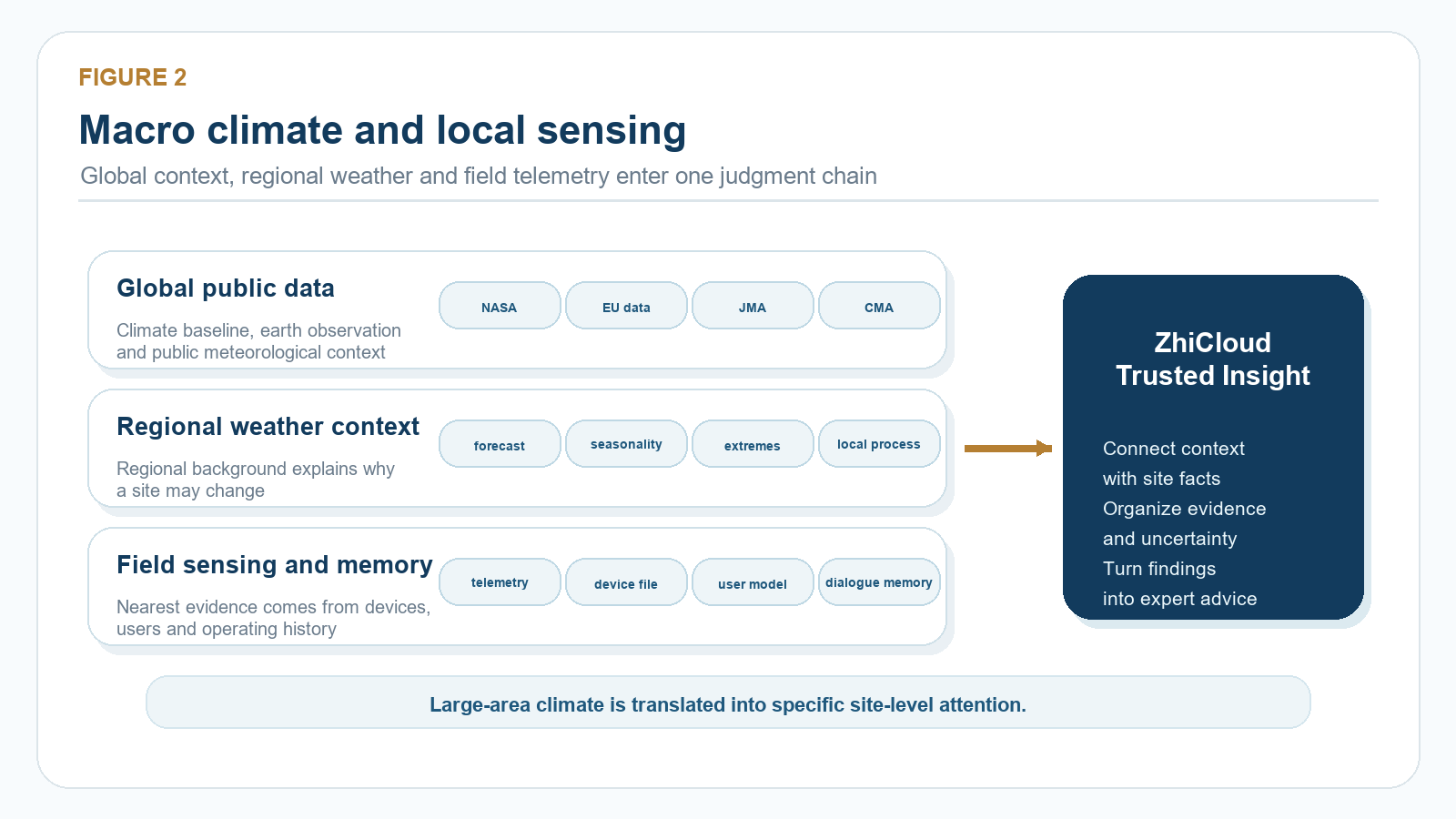
ZhiCloud translates large-scale change into local facts that customers can understand, placing public data and continuous field sensing in one assessment chain so global perspective and local accountability meet at the same decision table.
The global map shows environmental data expanding from research material into a public and industrial asset. The advantage belongs to organizations that can turn data into trusted understanding for preparedness, operation and coordination.
Climate risk increasingly affects urban resilience, food security, water, transport and energy at the same time. Environmental information has therefore expanded from specialist research material into a foundational asset for public management and industrial operation. Its value depends on continuity, transparent provenance and usability in specific decisions, not only on geographic coverage.
Open data systems lower the threshold for macro context, but field action still requires local sensors, project history and accountable procedure. Competitive capability comes from placing global trends, regional processes and local sites in one cognitive frame while preserving the scale and conditions of each source.
Special topic 03 The international data ecology: from Earth observation to business context
NASA Earth observation and Earthdata, the European Union’s Copernicus programme, Japan Meteorological Agency observation and forecasts, and China Meteorological Administration public services each contribute to the world’s environmental understanding. Their coverage, update rhythm, spatial scale and professional language differ, creating a layered global data landscape.
Useful synthesis is not a list of source names. It understands time, space, theme and applicability. Satellite observation offers broad context; forecasts describe a future window; regional monitoring shows local conditions; field devices place change at a specific location, indicator and accountable role.
ZhiCloud organizes multi-source evidence around a business judgment: see the environmental question first, understand the source relationship next, and then decide what deserves review, communication or action.
NASA, the European data ecosystem, the Japan Meteorological Agency and the China Meteorological Administration represent different layers of environmental knowledge. ZhiCloud treats them as part of a public data ecology and focuses on responsible multi-source assessment.
NASA Earthdata organizes Earth-observation material, Copernicus provides climate and environmental data services, WMO connects global meteorological observation and assessment, and JMA and CMA provide regional forecast and public weather information. The sources differ in spatial resolution, update frequency, product type and intended audience.
Responsible use records the product, time version, coverage and update state and distinguishes observation, reanalysis, forecast and assessment reports. ZhiCloud starts from the business question and selects appropriate background material; it does not compress incompatible scales into one number or claim that every public source fits every project.
Special topic 04 A changing world: from long trends to momentary disturbance
Environmental change has climate-scale trends spanning decades, weather shifts measured in hours, and device fluctuations visible within minutes. Long trends shape baseline risk, seasonal rhythm shapes preparation, short disturbances alter the field and telemetry provides the closest evidence of local fact.
Putting these time scales together avoids two errors: using a broad trend as a substitute for field evidence, or treating a momentary movement as a long-term direction. Environmental intelligence lets the scales correct one another, giving a trend a local anchor and a local change a wider context.
The output is not a context-free point estimate, but a trusted view organized around a time window, direction of change and strength of evidence.
Environmental change is complex because long trends and short disturbances coexist. Heat risk, heavy rainfall, water-level movement and local icing may all be produced by the interaction between global background and local conditions.
Long-term warming, changes in oceans and the water cycle, extreme-event risk and ecosystem pressure form the broad background of environmental change. Urban heat, short intense rainfall, local wind and point-level device movement occur on shorter scales. Both exist together, so a site view must not ignore long trends or replace field evidence with them.
Multi-scale analysis can follow a baseline-process-response structure. Historical and public material defines the baseline, regional weather describes an event process, and field devices record local response. When these layers align in time, teams can judge whether a signal is normal variation, event influence or a characteristic requiring longer attention.
China's policy landscape
Special topic 05 Regional climate and local sensing: making monitoring specific
Regional climate data answers ‘where is the environment heading?’ Local sensing answers ‘what is happening here now?’ The first supplies direction and context; the second supplies location and detail. Together they turn environmental monitoring from an abstract trend into a specific object.
In parks, roads, farms, rivers, mountains and energy assets, one weather process can produce very different local responses. ZhiCloud places device, indicator, area and time window in one context, allowing users to move from regional change to a point of interest and back again.
This is a cognition path from the large to the small and from the small back to evidence: broad data helps discover, local data helps confirm and the agent helps organize the question.
Regional climate gives direction; local sensing gives fact. Historical records show whether a change is unusual, and industry knowledge determines what deserves attention first. ZhiCloud compresses these layers into usable assessment.
Regional information can indicate air-mass movement, rainfall distribution, temperature anomaly and climate background, but it does not naturally describe the condition of one mine, road segment or field. Local sensors provide facts closest to action, yet without a regional reference an isolated movement can be mistaken for a general trend.
The connection depends on spatial and temporal alignment. A platform must show which regional process includes a site, whether field movement agrees with public material, whether nearby points differ and whether the device record is complete. Regional context can then explain without covering local facts, and local data can verify without claiming excessive representativeness.
Special topic 06 Cloud-edge collaboration: continuity and immediacy together
Environmental data gains value from analytical depth and response continuity. The cloud is suited to long records, cross-region comparison and organizational memory. Edge capability close to the field helps maintain local sensing, quick judgment and timely notice when connectivity is unstable or an event moves quickly. Cloud and edge are complementary foundations.
In business terms, collaboration means one environmental fact can be understood from several positions. Field teams focus on the present and the executable; the cloud focuses on trends and coordination; leadership focuses on the whole and on accountability. The platform connects these views without trading away either immediacy or context.
ZhiCloud treats traceability and responsibility boundaries as prerequisites, keeping environmental understanding readable, reviewable and continuous across different connection conditions.
Cloud-edge collaboration is a practical requirement. The field needs immediacy, management needs continuity and regional analysis needs long-term memory. ZhiCloud connects these views into one environmental understanding.
The edge sits closest to devices and field operations, supporting continuous collection, basic quality checks and immediate visibility. The cloud brings together histories across sites, public material and organizational records for longer periods and larger-area assessment. This division prevents field awareness from waiting for every centralized process and prevents regional analysis from being limited to one location.
The business result is continuity. A site retains critical status during network disturbance, records rejoin a complete series when connectivity returns, managers compare regions and specialists reconstruct events. What moves between cloud and edge is identified environmental fact and context, not two disconnected conclusions.
Special topic 07 The next agent paradigm: from answering questions to organizing judgment
Earlier intelligent applications mainly answered ‘what can be seen’. The next environmental agent also addresses ‘how should it be understood, compared and carried forward’. It is not an isolated chat window, but a continuing judgment organized around object, time, evidence, role and responsibility.
The core of an industry agent is not human-like style. It is the connection of professional context, continuous data and organizational work. Global assistance opens the conversation; data overview establishes the fact sheet; anomaly insight creates an observation lead; forecasting adds time; multi-source assessment explains relationships; intelligent reporting preserves the view.
The agent therefore moves from answerer to cognitive collaborator, from one interaction to continuous work and from feature display to industry method.
The next agent paradigm is sustained context. Today’s question, yesterday’s device movement, last week’s report and tomorrow’s trend should all belong to one business chain around an environmental object.
A new environmental agent maintains context around devices, places and tasks rather than answering only one question. An anomaly explanation becomes background for a later inquiry, a report becomes a baseline for comparison, and a professional review can refine the organization's understanding of a recurring pattern.
The interaction moves from supplying an answer to organizing judgment. The agent identifies scope, retrieves relevant facts, explains relationships, keeps open items visible and lets the user pursue the reasoning. Customers experience advancement as a more continuous workflow, while implementation detail remains outside the public disclosure surface.
Special topic 08 Agents and IoT devices: a new fusion for sensing the world
IoT devices make the world measurable, while agents make measurement understandable. When they converge, a device is no longer only a terminal that reports values and an agent is no longer only a text tool. Together they form a sensing-and-understanding unit for real environments.
When an agent can keep a conversation around device, indicator, location and time, telemetry gains context. A user can ask whether a deviation persists, how far a trend may matter and which point deserves verification next.
ZhiCloud’s environmental agents are driven by real device data and serve observation, assessment, briefing and reporting. AI approaches the physical world through IoT sensing while human confirmation and accountability remain explicit.
IoT devices give agents contact with the world. Rainfall, humidity, wind, displacement, turbidity, gas concentration and soil moisture are environmental signals; ZhiCloud translates them into customer-facing judgment.
IoT devices turn rainfall, temperature, wind, displacement, gas, water and soil conditions into continuous records. The agent places those records in location, time, weather, sector and user-task context. Users no longer face unrelated values; they can question an environmental object whose history remains available.
Devices also constrain the agent to evidence. Interpretation should return to actual telemetry, quality and historical movement; trends should state their window; suggestions should leave field confirmation intact. Allowing an agent to sense through instruments does not remove verification. It gives professional verification more complete material.
Global environmental change and public data
Special topic 09 Data iteration: every observation becomes the next starting point
Environmental data is not a one-off input; it is a living organizational memory. New telemetry supplements present fact, history provides comparison, human review corrects interpretation and seasonal or regional context changes what matters. Continuity gives judgment a sense of time; disciplined review gives an organization learning capacity.
Platform evolution should not aim to change conclusions invisibly. It should improve data quality, evidence relationships and stable industry language. Through repeated use, an agent can accumulate reusable environmental context so similar questions are understood faster and different questions are kept distinct.
This is self-improvement in a governance sense: capability evolves while fact, boundary and responsibility remain traceable.
Data iteration means no new observation stands alone. Incoming telemetry should relate to baseline, season, user concern and field feedback. The agent improves by understanding devices, scenarios and user language better.
New telemetry changes the current situation, field notes add operational context, a weather event can reinterpret a curve, and a confirmed response becomes a future comparison. Iteration is therefore more than adding rows. It continually refines what an organization understands about an object, its baseline and its anomalies.
Sustainable improvement preserves version and causal boundaries. Original observation, later interpretation and review outcome remain distinguishable, along with the period and source version used. Experience can be inherited, errors traced and the agent's understanding of devices and users improved through real feedback.
Special topic 10 Environmental big data: from accumulated scale to cognitive depth
The meaning of environmental big data is not only volume. It is the ability to compare across time, region and sector. Long records reveal patterns, real-time data reveals movement, cross-source evidence reveals relationships and field review reveals consequences.
When accumulated data and agent analysis meet, ‘many records’ can become ‘a few important judgments’. ‘What happened before’ can become ‘what deserves attention now’, and separate interpretations can become coordination around one fact base.
ZhiCloud turns data accumulation into infrastructure for continuous assessment, moving environmental monitoring from data asset to cognitive asset.
Environmental big data becomes valuable when it stops being a heavy archive and starts supporting recognition. Long records support trends, historical cases support current assessment and organizational experience supports future decisions.
The cognitive value of scale comes from comparison. Multi-year histories expose seasonality, multiple sites reveal spatial difference, several indicators show interaction, and event archives reveal how similar conditions produced different outcomes. Without consistent object, time and quality labels, a larger collection can make stable judgment harder.
ZhiCloud uses accumulation to establish background rather than assert certainty. Users can ask whether a movement is common in history, which conditions accompanied it and which verification steps were taken before. The archive becomes queryable organizational experience that continues to be corrected by new data and professional review.
Special topic 11 Global climate data and local forecasting: the value of multi-scale foresight
Global climate data supplies long context, weather forecasts provide a near-term window, regional environmental data shows meso-scale movement and telemetry supplies local fact. Connecting the scales produces business foresight: what merits preparation, what needs closer observation and what requires professional review.
Forecasting is valuable because it organizes attention earlier, not because it manufactures certainty. It can inform inspection order, resource staging, production rhythm, briefing agendas and public communication, and it can be reviewed later against what actually happened.
ZhiCloud places foresight back inside evidence and boundaries, giving future judgment both a broad horizon and a local anchor.
Combining global climate data and local forecasting allows users to see both background and immediate windows. For roads, agriculture, water and urban operation, this supports patrols, resources, staffing and communication.
Global climate material describes direction, seasonal products provide a longer preparation window, weather forecasts describe near-term processes, and telemetry records site response. Combining them into one result produces false precision; organizing them by scale supports planning, preparation, dispatch and verification as separate decisions.
Local forecasts must return to real sites. Road teams combine low temperature with pavement condition, farms combine rainfall with soil moisture and crop stage, and water teams combine rain, flow and quality response. ZhiCloud uses multi-scale reference to create useful lead time while stating that forecasts do not replace field checks.
Special topic 12 Industry knowledge in the agent: from general language to professional judgment
Environmental governance needs more than general language. Weather, geology, roads, agriculture, gas and water each carry different observation priorities and responsibility contexts. Industry knowledge helps an agent recognize what deserves attention, what relationships need checking and where human review must remain explicit.
ZhiCloud organizes domain knowledge as customer-facing judgment language built around observation, interpretation, trend, recommendation and review. The same data may create a different discussion in a different sector, while the underlying fact remains stable.
An industry agent does not turn expertise into a mysterious black box. It makes expertise easier to bring into collaboration and cross-department briefings.
When industry knowledge enters the agent, answers move beyond general explanation. Agriculture, mining, roads, water and gas safety require different objects, indicators and responsibility languages.
Industry knowledge determines how a change should be questioned. Displacement requires geological and operational context, gas concentration requires wind and position, water quality requires upstream-downstream and hydrodynamic context, and agricultural indicators require crop stage. General explanation alone rarely creates a useful review direction.
When knowledge enters the agent, it changes question structure, evidence choice and expression depth rather than merely adding terminology. The platform first explains status in familiar operational language, preserves deeper material for specialists and leaves final responsibility with qualified roles.
Regional climate and local sensing
Special topic 13 From warning to assessment: upgrading environmental risk awareness
A warning says ‘pay attention’. An assessment continues with ‘why, what impact and what should be observed next’. When warning, trend, device, weather and sector context are related, risk awareness no longer depends on one red signal; it is grounded in an explainable evidence chain.
This does not mean the platform replaces the accountable decision-maker. The closer a scenario is to public safety or production responsibility, the more clearly the basis, period, uncertainty and review route must be shown.
ZhiCloud elevates a warning into discussion-ready insight, helping organizations move from reaction to preparation.
Moving from warning to assessment means moving from ‘pay attention’ to ‘why this matters’. A warning gains governance value when it is placed in time, place, trend and evidence relationship.
A warning generally says that attention is required. Assessment asks how long a change has persisted, whether related indicators moved, whether regional context supports a view, which object may be affected and who confirms it. The signal becomes risk material with temporal, spatial and accountable context.
A mature assessment does not overstate incomplete information. It can state what present evidence supports, which explanations remain open and what observation should be added. ZhiCloud improves understanding and consultation before formal action, reducing unnecessary response without overlooking material change.
Special topic 14 From dashboard to workflow: environmental intelligence in daily work
A dashboard answers ‘where is the information?’ A workflow answers ‘who does what, when and on what evidence?’ Environmental intelligence becomes real when assistance, overview, insight, forecasting, assessment and reporting enter meetings, inspections, briefings, handover and review rather than stopping at display.
With one fact sheet, leadership sees the situation quickly, specialists inspect the evidence and coordinators follow open questions and review outcomes. The platform becomes part of organizational memory instead of an isolated application entrance.
ZhiCloud feels advanced when complex environmental judgment fits naturally into the rhythm of everyday work.
Moving from dashboard to workflow means environmental intelligence enters meetings, patrols, handovers, reviews and reports. Users do not only watch values; they use insight in daily work.
A dashboard creates shared visibility; workflow connects visible information to responsibility. An anomaly becomes an inspection task, a trend enters a consultation agenda, a review outcome returns to the device file, and a stage conclusion becomes a report available during handover. Without these links, visual polish does not change institutional operation.
Once environmental intelligence enters workflow, field staff add facts, specialists explain relationships and leaders set resources and priority around the same object. Dialogue, reporting and records complete a loop so an event remains available as experience after immediate handling ends.
Special topic 15 Trusted data: traceable, explainable and reviewable
The credibility of environmental intelligence comes from its evidence chain. Every consequential view should return to a clear object, time window, source and responsible role. Every trend should distinguish fact, interpretation and open question. Every recommendation should preserve a route for human confirmation.
Trust does not mean appearing all-knowing. It means being clear about what is known, what is uncertain and who must confirm the next step. For public-sector and enterprise users, this restraint is the condition for durable adoption.
ZhiCloud places traceable evidence and understandable business language on the same plane, building sophisticated intelligence on reviewable fact.
Trusted data requires an evidence order that an organization can accept. Key judgments should show source, window, inference and confirmation route. This is more important than a dramatic conclusion.
Trusted data carries source identity, collection time, object ownership, quality state and change history. A value that cannot be tied to a device, period or possible maintenance influence should not support a high-consequence view. Traceability is the common foundation for interpretation and accountability.
Explainability does not require publication of internal methods. It requires customers to see which facts support a view, which relationships are inferred and which changed conditions would require reassessment. Reviewability returns users to original records and related material, allowing agent output to serve serious work rather than becoming an unquestionable conclusion.
Special topic 16 Open collaboration: connecting global public data with local responsibility
Global public data gives environmental governance a wider horizon; local sensors bring responsibility to a specific area. Combining open information with customer data requires respect for source, authorization, time and applicability, as well as a translation into language a local organization can use.
From global climate context to an urban micro-environment, and from cross-region movement to one device, data creates value by forming a continuous cognitive layer. Sources do not need to be flattened into one number; their differences and relationships should remain visible in assessment.
ZhiCloud connects world information and local governance in an open but careful way, so global change serves a particular person, place and action.
Open collaboration combines global public information with local responsibility. Public data provides horizon, customer devices provide fact and human review closes the responsibility loop.
Open data widens environmental perspective while local devices keep judgment close to the accountable site. Their combination must respect authorization, update time, spatial scale and usage notes and must preserve disagreement. The objective is to increase useful evidence, not erase differences among sources.
Cross-department collaboration also needs boundaries. Meteorological, ecological, transport, agricultural and emergency roles can share an environmental background while making decisions under their own mandates. ZhiCloud reduces repeated checking through common objects and evidence links, bringing public information into specific local action.
Cloud-edge coordination and the agent paradigm
Special topic 17 Green development and industrial upgrading: the economic meaning
Environmental intelligence serves ecological governance and industrial efficiency. Energy, agriculture, transport, water, parks and public facilities must balance resource limits with environmental uncertainty. Earlier detection, better preparation and more complete evidence are themselves capabilities for green development.
When environmental data enters production planning, asset stewardship and public services, it can become risk control, efficiency and long-term resilience. The agent helps that value become visible and collaborative sooner.
Through ZhiCloud, Zhice Yunlian moves environmental information from recording outcomes toward supporting high-quality growth.
Green development and industrial upgrading are practical. Better environmental judgment can reduce ineffective patrols, lower sudden risk, improve resource use and support long-term compliance.
Green development requires organizations to consider environmental quality, resource efficiency and production continuity together. Earlier recognition of water-use anomalies, thermal conditions, emission movement or road-weather risk can reduce wasted work and sudden loss while supporting energy, emission and operational management.
Economic value extends beyond reducing screen time. Better environmental judgment improves resource allocation and long-term readiness. Enterprises can include environmental conditions in production plans, and governments can target public-service deployment more precisely, giving industrial upgrading a measurable environmental dimension.
Special topic 18 Organizational resilience: keeping judgment continuous in an uncertain world
Extreme weather, infrastructure pressure and supply-chain volatility continually change how organizations face environmental issues. A resilient organization is not one without uncertainty; it is one that can form common fact, set responsibility boundaries and review outcomes while uncertainty remains.
Continuous sensing, trusted assessment and reusable reports reduce information breaks, handover loss and repeated interpretation. Staff changes do not reset environmental understanding to zero, and an event does not erase its lessons.
ZhiCloud turns each judgment into the starting point for the next collaboration, giving an organization environmental memory for the future.
Organizational resilience means keeping judgment continuous through staff changes, extreme weather, project transitions and cross-department work. ZhiCloud preserves memory through files, reports and conversations.
Extreme weather, device change, staff turnover and cross-department work test whether judgment can remain continuous. Resilience means retrieving background, understanding prior decisions, identifying current differences and preserving the new outcome rather than restarting analysis during every event.
ZhiCloud connects device files, dialogue context, report versions and review records across time. New owners can trace long-term status and open questions even when project staff changes. Once environmental understanding moves from individual memory into an institutional asset, uncertainty has a more stable foundation.
Special topic 19 Zhice Yunlian: sensing the heartbeat of Earth
Earth’s heartbeat appears in moving winds, changing clouds, rising rivers, breathing soil, road temperature and the subtle movement continuously returned by every device. Environmental monitoring records these signals; environmental intelligence helps people understand them.
Zhice Yunlian does not treat ‘sensing the Earth’ as a slogan. It makes the idea concrete through reviewable objects, continuous periods, sourced evidence and responsible judgments.
ZhiCloud connects broad environment and local field, global information and local action, IoT devices and industry agents. It helps change be heard earlier, expressed more accurately and answered with greater composure.
‘Sensing the heartbeat of Earth’ is a concise expression of the company’s positioning. Change enters the platform through sensors, becomes understanding through agents and returns to governance through action.
“Sensing the heartbeat of Earth” becomes concrete at many scales: a regional weather process, a river's quality movement, subtle slope displacement or the moisture rhythm of a field. These are expressions of Earth systems at particular places, and sensors allow them to leave continuous records.
Zhice Yunlian makes the records understandable and usable. ZhiCloud places microscopic fact in regional and global context, translates specialist material into views that different roles can discuss, and returns the result to inspection, governance and production. The statement joins brand purpose with product mission.
Special topic 20 Conclusion: environmental intelligence as the next foundation
From Digital China and global climate governance to satellite observation and local sensors, from cloud knowledge to field action, environmental intelligence is becoming a new foundation. Its core is not more features, but sustained collaboration among data, agents, devices and accountable people in one cognitive frame.
ZhiCloud represents the path of an environmental agent cloud platform independently developed by Zhice Yunlian (Qingdao) Intelligent Technology Co., Ltd.: real data as the starting point, multi-source assessment as the method, industry knowledge as the support, trusted boundaries as the prerequisite and organizational continuity as the value.
In the years ahead, environmental intelligence will help more public-sector and enterprise organizations stay clear, composed and ready to act in a changing world. Sensing never stops; judgment keeps advancing; governance gains a new kind of confidence.
The conclusion is that environmental intelligence is becoming a new foundation. Through ZhiCloud, Zhice Yunlian combines IoT, public data, industry knowledge and agents to move monitoring from data visibility to world understanding.
Environmental intelligence becomes foundational when data, knowledge and accountability continue to move through an organization. Users need not wait for a few experts to transfer every piece of information, and specialists need not repeatedly restate the same background. A shared factual base and layered expression allow more roles to participate within proper boundaries.
ZhiCloud is Zhice Yunlian's response to the next generation of monitoring: real devices begin sensing, public data widens perspective, industry knowledge preserves context, agents shorten understanding, and human review protects responsibility. Their continued combination brings environmental data into governance and industrial decision systems.
Data accumulation, industry knowledge and organizational memory
Special topic 21 Research team and academic background: an interdisciplinary foundation
ZhiCloud Environmental Agent Cloud Platform is independently developed by Zhice Yunlian (Qingdao) Intelligent Technology Co., Ltd. Its research and product team brings together high-caliber graduates and interdisciplinary professionals associated with the University of Sydney, Northeastern University in the United States, Beijing University of Posts and Telecommunications, the University of Technology Sydney, Anhui University of Technology, Shandong University, Peking University, Tongji University and Communication University of China.
Different academic perspectives contribute different ways of seeing. Environmental and geoscience perspectives focus on natural processes and their limits; information and computing perspectives focus on continuity and expression; engineering perspectives focus on devices, field conditions and dependable operation; communication and management perspectives focus on how complex findings become shared understanding and coordinated action.
This describes the team’s academic composition and professional capability. It does not imply an official university partnership, joint laboratory or institutional endorsement. Zhice Yunlian turns interdisciplinary talent into an independent development capability for environmental agents.
Academic backgrounds across universities support interdisciplinary capability while preserving a clear boundary: this talent structure strengthens Zhice Yunlian’s independent development system and does not imply official university endorsement.
An interdisciplinary team allows one environmental issue to be examined through natural process, sensing equipment, data continuity, software systems, sector responsibility and communication. ZhiCloud needs these perspectives to correct one another so complex environments can become a stable and usable customer product.
The team's educational and professional background includes the University of Sydney, Northeastern University in the United States, Beijing University of Posts and Telecommunications, the University of Technology Sydney, Anhui University of Technology, Shandong University, Peking University, Tongji University and Communication University of China. This describes talent composition, not official partnership, a joint laboratory, co-development or university endorsement; Zhice Yunlian remains the developer.
Special topic 22 Cross-disciplinary intelligence and agent methodology: making complex environmental issues understandable
Environmental issues are naturally cross-disciplinary, cross-scale and cross-departmental. A slope movement can involve geology, rainfall, groundwater and field operations; an urban storm can affect roads, drainage, parks and public communication. A single specialty rarely covers the full context, so effective environmental intelligence must bring different knowledge into one judgment.
Zhice Yunlian organizes cross-disciplinary work around the question at hand. It defines the object and responsibility first, places telemetry, regional conditions, public evidence and sector knowledge in one narrative, then expresses change, evidence, uncertainty and next steps in language the user can apply.
The method does not use jargon to create distance. It turns professional depth into decision material that leaders, specialists and field teams can each understand from the same fact base.
Cross-disciplinary methodology turns complexity into understandable judgment. Environmental science defines objects, IoT provides facts, data engineering organizes continuity, agents express insight and industry research provides responsibility context.
Environmental science identifies objects and natural processes, IoT engineering obtains continuous facts, data engineering preserves temporal and spatial relationships, software systems provide dependable delivery, sector research explains responsibility, and communication makes complex views understandable. The disciplines jointly complete one chain of judgment rather than decorate a list.
The method works backward from the business decision: who must decide what in which setting, which facts must remain visible, which background is relevant and which boundary requires human confirmation? This approach prevents technology display from drifting away from the field and prevents simplified language from losing professional depth.
Special topic 23 Industry focus: weather and urban environmental intelligence
User pain and traditional friction: heavy rain, heat, gusts and waterlogging often arrive in one urban process, while device readings, weather material, park operations and historical reports remain separated. Leaders switch between screens and ask specialists to assemble a shared situation.
ZhiCloud places rain, temperature, humidity, wind, waterlogging and device status in regional weather and historical context. A user can ask: ‘Which areas deserve attention today, and what should we prepare for in the next few hours?’ The agent gives a concise view first, then expands evidence, pace, influence and open checks.
One-sentence briefing: ‘Rainfall and local waterlogging signals are strengthening in the priority area; the short-term movement needs continued observation, with low points, drainage routes and outdoor work as the first review objects.’
Leaders receive a situation summary, specialists receive evidence relationships and field teams receive a review direction. The urban agent turns a general forecast into preparation connected to real places and assets.
In weather and urban environments, customers need forecasts and local monitoring to be connected. The agent helps identify which areas, periods and facilities deserve attention, making urban preparedness more specific.
Urban weather affects specific roads, drainage assets, facilities, schools and public activity. The same rainfall produces different responses under different terrain and surface conditions, while heat affects dense and open areas differently. Regional forecasts must be paired with local rain, temperature, humidity, wind and event history to support practical preparation.
Users can ask which areas deserve attention in the next hours, whether sites have begun responding and which facilities need earlier inspection. ZhiCloud connects a weather process to urban sensing objects, giving leaders a situation view, specialists an evidence path and field teams a priority order.
Special topic 24 Industry focus: geology and mining environmental intelligence
User pain and traditional friction: mines and geological sites must consider displacement, cracks, rainfall, groundwater and operational disturbance together. One curve rarely explains whether movement persists or whether it aligns with a weather process, and non-specialist leaders struggle to read the field meaning.
ZhiCloud organizes local sensors, regional rainfall, history and field feedback into one assessment context. A user can ask: ‘Is movement at this slope persistent, and what should the field team verify?’ The agent separates observation, association and open uncertainty.
One-sentence briefing: ‘Recent displacement at the target slope shows a time relationship with the rainfall window; current evidence supports closer observation and field verification, including cracks, drainage and groundwater.’
The mining agent shortens the path from curve to inspection plan, preserves evidence for specialists and translates complex analysis into clear checks for field crews.
In geology and mining, customers ask whether movement continues, whether rainfall or activity may matter and what field checks are needed. ZhiCloud translates technical signals into management and field review language.
Slope and mine environments require displacement, cracks, rainfall, groundwater, temperature and operational disturbance to be reviewed together. One displacement curve does not determine risk; velocity, persistence, agreement among nearby points and correspondence with external processes often provide stronger grounds for verification.
ZhiCloud organizes history, weather background and field records around a monitored object and helps identify sites needing closer observation or inspection. It provides layered assessment material without replacing geological evaluation or safety authority and shortens the path from detected movement to an organized review.
Trusted intelligence and interdisciplinary research
Special topic 25 Industry focus: road and traffic environmental intelligence
User pain and traditional friction: road operation depends on surface temperature, water, ice, visibility, crosswind and traffic rhythm. A general forecast cannot represent every road segment, while maintenance, traffic control and field patrols often use separate information channels.
ZhiCloud puts road observations, device trends, regional weather and historical periods into a question-driven environmental record. A user can ask: ‘Which segments need attention for ice or low visibility tonight?’ The agent provides priority, contributing conditions and field checks.
One-sentence briefing: ‘Cooling and moisture may overlap on selected segments overnight; bridges and shaded sections deserve priority review, alongside visibility and crosswind conditions.’
Road intelligence helps leaders plan, maintenance teams schedule patrols and field staff locate priority segments, turning broad severe-weather preparation into specific road awareness.
In road traffic, users need to connect pavement temperature, moisture, visibility, crosswind and weather process. The agent turns weather into segment-level attention and maintenance preparation.
Road environments are linear and locally diverse. Bridge decks, tunnel portals, shaded segments and high-altitude roads respond differently to cold, precipitation, visibility and crosswind. Regional weather alone cannot set maintenance priority without pavement temperature, slipperiness and field records.
The agent combines weather windows, critical segments, event history and current sensing to answer where to inspect first, when to check again and which conditions may continue. Managers prepare people and materials, specialists inspect the basis and field teams receive a clearer route.
Special topic 26 Industry focus: agricultural environmental intelligence
User pain and traditional friction: agriculture must understand soil moisture, frost, evapotranspiration, leaf wetness, irrigation opportunity and weather rhythm. Farmers move between sensor dashboards, weather apps and experience, but still need a concise recommendation for each field.
ZhiCloud organizes field sensors, near-term weather, seasonal rhythm and crop focus into a continuing conversation. A user can ask: ‘Should these fields be irrigated today, and what should we watch over the next few days?’ The agent explains the relation between moisture and weather before suggesting an observation window.
One-sentence briefing: ‘Several fields are trending toward lower moisture, but near-term weather may change evaporation and replenishment; verify representative points before setting the irrigation rhythm.’
Agricultural intelligence gives operators a clear view, keeps professional judgment visible and turns broad weather context into field-level timing.
In agriculture, users face weather, soil moisture, crop stage and irrigation rhythm together. ZhiCloud treats a field as a production environment that is continuously understood.
Agricultural interpretation must account for crop stage. The same temperature, rain or soil moisture means different things during sowing, vegetative growth, flowering and maturity, while soil, terrain and irrigation create field-level differences. Forecasts or one moisture point alone cannot support precise production planning.
ZhiCloud organizes regional weather, field sensors, historical movement and user notes into a field file. Users can discuss irrigation windows, thermal stress, disease-related environmental conditions and patrol priority. Suggestions remain tied to crop, field and time and are confirmed by agricultural personnel.
Special topic 27 Industry focus: gas-safety environmental intelligence
User pain and traditional friction: gas safety depends on concentration, wind direction, dispersion, ventilation, exposure and neighboring areas. A single-point alarm leaves leaders to manually check trend, location and field relationships.
ZhiCloud combines concentration movement, device location, wind context, history and field rules into a reviewable risk explanation. A user can ask: ‘Which directions may be affected, and which points should be checked first?’ The agent distinguishes observed fact, possible influence and conditions for confirmation.
One-sentence briefing: ‘The concentration change at the target point warrants attention; given wind and neighboring observations, review the downwind area, ventilation and personnel activity while watching whether the movement expands.’
The gas-safety agent clarifies influence for leaders, evidence for specialists and patrol direction for field staff while leaving final response with the accountable role.
In gas safety, users care about dispersion direction, affected area, ventilation and personnel activity, not only a concentration value. The agent places change in location, wind and history.
Gas concentration must be interpreted with substance properties, sensor position, wind, spatial structure, ventilation and human activity. A rise at one point may reflect local release, transport or device condition. It cannot alone define an influence area or replace emergency and safety authority.
ZhiCloud connects the concentration curve with environmental conditions and site history to examine persistence, response at nearby points, possible wind-supported direction and areas requiring verification. The output supports briefings and inspection preparation, while formal response follows site procedure and authorization.
Special topic 28 Industry focus: water-environment intelligence
User pain and traditional friction: water assessment involves level, flow, pH, dissolved oxygen, turbidity, conductivity, weather, hydrology and surrounding activity. A single metric may reflect rain, inflow, discharge, equipment condition or natural variation, so cross-source checking is slow.
ZhiCloud places water quality, hydrology, weather, devices and history in one environmental narrative. A user can ask: ‘What has changed in this water body, and which indicators deserve follow-up?’ The agent describes overall state, associated movement, open factors and the next observation window.
One-sentence briefing: ‘Turbidity and conductivity have moved in the same direction near the target water body, close in time to rainfall and level change; verify upstream and downstream points, device condition and nearby activity before assigning a cause.’
Water intelligence gives managers a combined situation, reduces repetitive comparison for monitoring teams and locates sampling and patrol priorities.
In water environments, no single indicator tells the full story. Turbidity, conductivity, pH, dissolved oxygen, water level and rainfall may be related; ZhiCloud organizes them into a reviewable chain.
Water movement is shaped by inflow, rainfall, velocity, temperature, upstream-downstream activity and device condition. pH, dissolved oxygen, turbidity, conductivity and water level describe different aspects. A single change becomes meaningful only in the process and time relationship of the water body.
ZhiCloud organizes multi-indicator curves, weather context, upstream-downstream difference and inspection records around a reach, section, reservoir or facility. A user can move from a situation briefing to source and trend questions and preserve material for sampling review, investigation priority and stage reporting.
Frequently asked questions
What is ZhiCloud?
ZhiCloud is an independently developed environmental agent cloud platform from Zhice Yunlian. It organizes real device data, regional environmental context, industry materials and continuous conversations into one entry point for questions, anomaly insight, trend analysis, integrated assessment and reporting.
How is ZhiCloud different from a conventional IoT dashboard?
A dashboard primarily displays measurements. ZhiCloud organizes the relationships among data, time, environmental context and evidence around a user's question, helping non-specialists understand a site and continue the inquiry.
Can the platform work with real monitoring devices?
For connected devices with mapped indicators, the platform organizes continuous telemetry, device records and environmental history so that an answer can return to a specific site, metric and time window.
What can a user learn from one question?
A user can ask about current conditions, material changes, recent direction, the device scope and matters requiring attention. The agent can present the result for managers, specialists or field personnel.
Is a trend forecast a certain conclusion?
No. A forecast supports attention to direction, time window and conditions. Complex environmental situations still require data-quality review, field confirmation, professional judgment and accountable procedures.
How does regional climate context improve local monitoring?
Regional weather, seasonal context and public environmental sources explain the wider setting around a site, while local sensors provide the nearest continuous evidence. Their combination makes monitoring more specific.
Which industry settings does ZhiCloud address?
The whitepaper examines weather and cities, geology and mining, road traffic, agriculture, gas safety and water environments, with practical value for managers, specialists and field teams.
Why do user models, dialogue memory and device records matter?
They preserve the user's objects of concern, usual time windows, device background and previous questions, improving continuity across briefings, handovers and reviews.
What role does intelligent reporting play?
Intelligent reporting organizes queries, trend observations, evidence notes and review items into shareable material for meetings, inspections, risk communication and periodic summaries.
What does trusted insight mean?
Trusted insight keeps conclusions connected to evidence, makes scope and time explicit, preserves uncertainty and requires human confirmation for consequential judgments. The platform supports decisions without replacing accountable roles.
Where should an organization begin?
Start with a scenario that has continuous data, clear responsibility, frequent questions and an existing field process. Use one real question and one recurring report to establish a verifiable loop.
Do the listed university backgrounds imply official partnerships?
No. They describe the educational and professional backgrounds represented in the team and do not claim official university partnership, joint authorship, certification or endorsement.
Edition and resources
Edition: 2026.08.15 · 2026-08-15